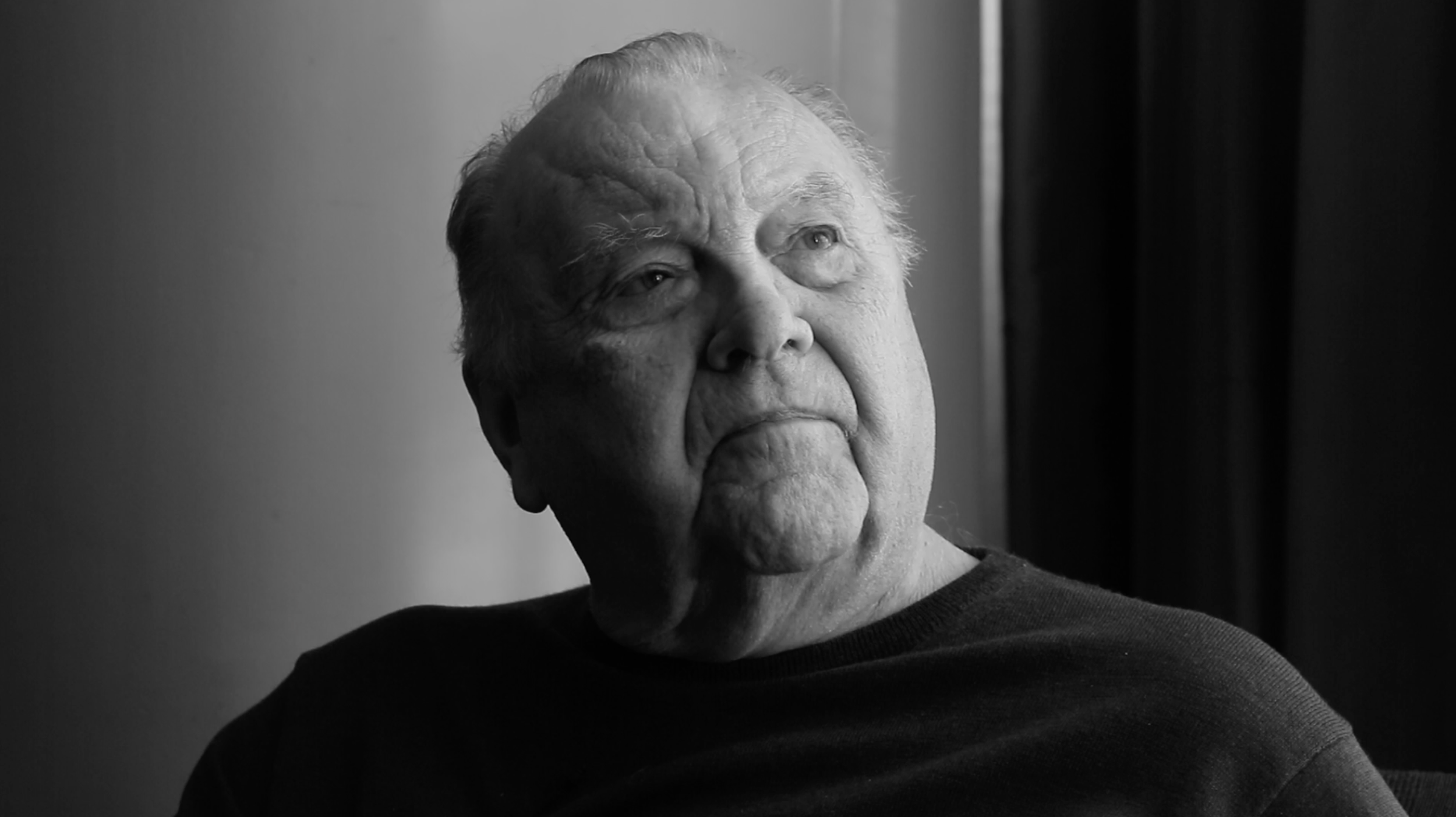
Matthías Johannessen (born January 3rd 1930) is an Icelandic poet and author. He has published dozens of books of poetry, scholarly articles, novels, short stories and conversations.
His works are heavily influenced by Icelandic heritage and culture, the islands natural environment and history.
The interview I conducted with poet Matthías Johannessen which is revealed in this paper, is part of a hybrid book and film project titled Worlds We Live In.
The idea for the project came to me as I was studying philosophy in 2007 at the University of Iceland, and it was simple - I wanted to visit the people who had made the biggest impact on my way of thinking, examining their outlook on life and personal spaces, with no seeming premise or subject to talk about.
In the hopes of gaining insight into their most personal selves, we would talk for hours about everything that came to mind, sometimes going nowhere, sometimes reaching intimite heights that otherwise wouldn’t have been accessible within a more prepared setting. Some live nomadic lives at the outskirts of civilization, others have carved out a niche for themselves in the city. The goal was to make their wisdom and worldviews accessible to the world, to put it into context, and learn from them.
We talked about love, life, death, beauty, nature, language, communication. We talked about what it means to be a human being.
The people I interviewed spoke their innermost truths. I was thankful for the trust the gave me. They didn't care about the carefully scripted life people tend to live in small, remote places like Iceland, especially if being part of it meant distancing themselves from honesty. During our conversations, all of the interviewees proved to be strong enough to leave their egos behind and had acquired the wisdom and skills to allow themselves to become vulnerable despite the camera and microphone sitting in front of them.
With Matthías, our meetings where conducted almost like an improvised play. I wanted to reach beyond his life as a public figure, discover his truth, and figure out if in the end, we are all really left without any solid answers on life’s mysteries despite our experiences and background. Although no definite answers where uncovered about life’s biggest questions, Matthías would still bring to light endless knowledge on any given subject we explored together.
Through my deliberate unpreparedness I found beauty and meaning as vibrant as I could ever have wished for. I earned the trust of the people I met and spoke with, and together we also learned to trust the moment. We surrendered ourselves to the unknown, accepted the fact that there was nothing for us to do other than to see what would happen. It didn’t matter if it was raining or if the sun was shining outside. We where sitting there, in that room, enraptured by the moment.
When I told Matthías I wanted to talk about nothing in particular, ask questions with no right or wrong answers, he wholeheartedly agreed to dive in. Together we went in, and got lost. We tried to help each other forward. My role was to listen intently, with all my heart - with truth and honesty, his was to open himself up to the conversation, let his guard down.
I have always been interested in the attempt to approach philosophy in the most neutral way, to further reveal our natural disposition - Telling yourself this is me being neutral your hidden dispositions become obvious impressions as your deliberateness is washed away. If you are up for the task you can take a look at yourself and see those impressions for what they are - how we are stuck to our own experiences, bodies, ideas, thoughts and culture. Attempting to be impartial, the attempt itself is justified even though we know it will fail anyways, as it leads us towards new pathways of thinking, paths that where built up by trying.
As we tried to look for meaning, essence, we where never able to come to any definite conclusion on the topic at hand. The connection itself that formed between us allowed the experience and feeling of vastness looming behind the questions posed to come forth. To change the impression the world had made on us before, our efforts made an impact although without direct tangible evidence. Nevertheless we definitely felt the exchange of thoughts happening between us - important truths that where so close to being within our grasp, yet they still remain so far away.
It’s an interesting foundation for a documented discussion, what happens when we try to free ourselves from the information and worldviews available to us to hold onto, things we have absorbed from what others have thought before us. We avoided looking for answers from things we found clever in the past, we chose to rather find the answer within the essence that springs forth from our mutual communion. It is definitely a challenging practice, made more difficult in life as we absorb what we personally like to read, ideas we seek out and accept as good good enough answers to the most basic questions. I’m not even sure if this possible, especially if it the words of Raymond Williams are true, - that language is collective poetry and words can only operate at the collective level, which means thoughts that are truly ours can only be abstract and unique to each and every one of us. That also begs the question of whether it really matters, in the end?
I quickly realized the importance of trusting the silence that intermittently took over between us, how powerful it could be if we just let it happen, let ourselves enjoy the suspension rather than resorting to filling up all that empty space with words, if only because we felt like we had to. Like we owed it to the camera to speak.
The camera was rolling and when nothing seemed to be happening, those where the moments where things really got interesting, each frame appeared like a beautiful portrait embracing the light-hearted silence as Matthias paused to look up to think. Then he would adjust his shoulders a little bit, telling me that he didn't know the answer with body language, saying he had no clue.
His fingers drew pictures into the air, as he explained ideas that came to him.
At some point we must ask ourselves who we are. Sometimes the answer is so hard to find, so we make up stories about ourselves and hold onto those stories for the rest of our lives. Deep inside, after becoming adults, our essence is not a simple thing to draw forward, to bring into the light. The answers are never simply laid out. We allow ourselves to be certain things, and suppress other aspects of ourselves, try to forget them. “This is me…” We tell ourselves over and over again. Then we start talking again, to fill in the gaps, the silences, the void. “So listen this is what happened…” .
Once upon a time.
I have listened to stories about what it feels like to fall in love at first sight, how someone died for a few minutes and entered places without heaven or earth - what it was like to experience the hardships in Iceland early last century, memories of Germany during world war II... I imagined the images behind their stories, and between the lines drawn I saw a portrait of the person speaking so clearly. I saw them in how they told their story.
It took us a long time, but when Matthías ran out of stories and quotes and favourite sayings - he began to reveal himself as I had never seen him before. There he was - uncovered with all his reveries - and up until this moment, although he’d always been honest, he was now also bare, vulnerable and defenceless. At some point, for all of us, there really is nothing left to prove.
To be honest, for all of my friends that I visited it was almost impossible for them to run out of stories and interesting experiences - but ideas come and go, as we are flowing in the stream of the ever changing - this is what came to mind at this particular moment, then there is everything else, that is gone, and the things coming our way. That’s why I wanted it all to be unprepared.
If I had written the questions beforehand, I would have had them at an advantage, but also would have been more efficient in terms of capturing something in particular, like a journalist. It would have saved me a lot of time, it also would have been less challenging, less alive, less real. I would have missed out on all the fantastic mistakes. I can really feel the difference, as I listen to these tapes. The words are honest, perfectly placed in time, they where meant to be spoken - in tune with that given moment in time.
“I don´t know” and “just because” have become some of my favourite, most insightful answers from those interviews - there is so much beauty in not knowing. So much to be explored.
Matthías said “Whatever it is you are living through, you live it - no matter what your burden is” , and we continue on living, and are happy to think and be ourselves and part of the human race, happy to be detached from the whole - to be here, not there yet.
It is my sincere hope that this project inspires compassion with others, rooted in the experience of seeing the world through the eyes of another. Researching the human being from the factors that unite us, seeing yourself mirrored in other individuals. The more specific you get, the more universal your story will be. It doesn’t matter how things are articulated, in the end, across cultures, age and history - our attempts to finding answers all carry the same meaning in essence.
It enables us to to experience reality as a multi-layered phenomenon, embracing worldviews as ever changing snapshots of a complex fabric of thoughts, ideas and experiences. Within that zone, we attain the power to change ourselves, adopt new ideas through compassion, and grow - rather than holding onto onesided opinions for the rest of your life.
Worlds We Live In is an unconventional project since there is no particular topic or agenda to follow - it is meant to spark new thought-processes that could potentially instigate change within the viewer/reader and discover new facets of their reality, enriching the very personal inner viewpoint of the world already present within all of us.
*
RR: At this point we start improvising, it’s a fragile moment that won’t last without complete vulnerability and surrender to ones own limitations. It’s as if we have both become childlike, asking simple but big questions - about what this is, life. Since it was me who suggested we sit down for this conversation I guess it’s my responsibility to begin talking, to establish a flow of words and thoughts - since we can begin anywhere why not begin with one of the biggest question of all, the question of human life.
MJ: There are some connections to life’s secrets that we aren’t familiar with, which is in many ways a great thing - the brain hasn’t worked it out yet. We live here, in this world. Here it is and we call it Earth. Perhaps humans where just an experiment by God to create something good, maybe it was a failed experiment. God gave Man free will and Man has not used it for good. Man always seems to mishandle freedom. One day Man will break out of his rigid shell and all of a sudden see something new - maybe it will be divine mutation - I won’t eliminate the possibility - why would I do that when I have seen all sorts of strange things happen. Think about Dinosaurs, a reality greater than any adventure you can possibly think of. I have no idea why Dinosaurs emerged, maybe they where a different experiment, I don’t know. All these analytical and empirical theories are monuments to how little we actually do know. It’s an alibi for not knowing, we are faced with to much uncertainty, this whole experiment is in full swing. The laboratory is so big, you just stop thinking about it as much, as you grow older - because what we’d all like to know more than anything else, are the things beyond what we can conceive of in this life. I have looked into the darkness so many times and asked why, and why don’t I get an answer? If there really is a creator behind this all why can’t he tell me where Hanna is, why am I not allowed to know where she is if she is somewhere to be found. Asking without getting answers, that’s how magic is. It doesn’t help hanging onto these things, life is reality only in how we perceive it, and it is that reality we must learn to deal with. I never believed I would really grow to be old, and I’m still here telling myself I should continue on living - it’s not up to me really, but it’s still my decision, to try and live life in the most beautiful way. I don’t get hung up in why I am still here alive and breathing but I thank God for being able to stay here in the comfort of my own home, relatively healthy and able. Thinking about this existence in too literal terms will only cause you depression, you can’t quantify everything and get answers to it all - it’s just not an option.
RR: So we are stuck, but don´t you think that us humans are improving with time, that we are moving forward towards something positive, maybe even getting some answers as we go on?
MJ: When I was a young journalist an old man said to me, “You can’t tell me nothing. I am a thousand years older than you are.” - I said “Well, how can that be?”, and he replied “I was a contemporary of Egill Skallagrímson (historical Icelandic figure), you where not.” I thought to myself, well OK, technically he is right - but there was no gap between us, the world had only advanced technologically - humans had stayed the same. Man will try to control everything in his reach, and we as humans collectively seek to be controlled. Ant colonies can tell us a lot about ourselves. We are just like them, and know nothing more than the common ant. We may have made technological discoveries, but we are still stuck here. We are confined to this earth, and our neighbourhood is empty cold space backlit by stars. Even the far away is just empty space. It seems infinite, but what do we know? We can’t see further than the ant. And myself, having lived a successful and fulfilled life, what do I control - I could lose my house in an instant, I have no control whatsoever, and never did.
RR: But most of us seem to have at least some kind of conscience, which should help guide us. Do you believe we are born with it, or do we acquire it later in life?
MJ: Yes, I sometimes believe conscience is God telling us to stop. “Look here now, this won’t do”. I think conscience lives in our frontal lobe and that there is nothing miraculous about it’s function. If we had no conscience there wouldn’t be a place for us in this world, which is why it serves such an importance in most religions. So many marriages have avoided disaster because something tells them No. Could that be God? I have no idea. Ethics emerge from efforts to try and define and quantify conscience - what is good and what is bad - I don’t know about that whole deal, I guess I’m too much of a Bohemian to even go there.
RR: How do you experience getting older in our society?
MJ: Society is always trying to create generational gaps, old people are written off as soon as they stop working - you lose your health in terms of your relationship with your environment. You still learn a lot as you grow old, it’s an education in many things, but you cease to be part of the greater societal equation. I feel like society should find different ways to deal with old age, to let it’s elders enjoy themselves and express what they have learned, instead of putting them away into yet another cage to live out their days. Old people should be allowed to participate, have roles in their communities. Healthy elders can be youthful when communicating with young people. I am worried that if I went to a nursing home I would become the oldest person in there, that the environment would draw out the age difference in me. You understand, it’s not certain I’m right or that I’m being completely fair right now, but thats another story.
I have of course known a lot of people during my lifetime, and published quite a few books on conversations.
RR: Mhm.
MJ: But I feel, one conclusion to draw from my experiences, is that pretty much all of the Icelandic people I have spoken with, they are, they all share a belief in some sort of afterlife. It’s pretty remarkable.
RR: It’s true. There is general acceptance of the idea of an afterlife in Iceland.
MJ: Yes.
RR: Maybe it’s this certain connection we have to nature…
MJ: I think so too, you are right.
RR: It has an impact.
MJ: There is a great connection to nature.
RR: Mhm.
MJ: It’s enormous, we are such children on nature, and our fishermen, who all have gone to sea to fish, I have spoken to many of them, they are so, they have such faith that it’s incredible. One time I spoke with an old man. Þórarinn á Melnum.
RR: Mm.
MJ: He had a connection to god, he was well in his eighties, and he was always wearing overalls. He had some sheep, up on Ásvallagata, where he used to live, and he always had the latest news from the fishermen out on the sea. He was so religious, that he wouldn’t miss a single mass at church, but he didn’t like changing clothes at all, on Sundays. He couldn’t go wearing his overalls either, but that’s all he wanted to wear. Then the most revolutionary technological innovation in his life became the national radio stations broadcast of the mass, then he no longer had to change clothes on Sundays, he could just listen to the mass in his living room, in his overalls.
RR: Wow.
MJ: That’s what his faith was like.
RR: That’s amazing.
MJ: He was like, “Now I can get rid of my Sunday clothes, now I can listen to mass with my sheep. Out in the barn.”
*
RR: Why do you write?
MJ: Why in the world have I spent my life writing poetry? Why do I do that? I do it because there is something inside of me that is like a receptacle for things that come my way. Like that pinetree in my garden, look - I planted that tree - now it big and beautiful and one day in the month of april the birds started singing in it. All of a sudden the tree begins to sing. Real poetry comes to life in the same way. You can force all sorts of things to appear but in order for it to quicken the heart, you must let the birdsong into your heart. Then you can write about mundane things, it won’t even matter. Festiveness is most present in the mundane. I experience this world in a way that doesn’t require me to wear a shirt or tie, I don’t feel like I need to make unecessary gestures or pose in certain ways - to me the greatest festivity is found in the woolen shirt. You don’t have to be smothered in fancy clothes to find festiveness, because at that point vanity is near. It’s important to differentiate between the festive and the vain. I could never be a proper editor, because editors wear suits and I couldn’t.
A good quality in an artist is to be himself. Without pretense, just being himself in the way he believes in art. Being what he needs to express. Not thinking about what is popular or not. You must admire those artists who don’t care about what others think, they bleed so much for it, and it costs them so much. They often become very lost, but they are the real deal.The worst thing is when young talented people are being promoted but are obviously not artists. That’s like when carpenters start to demand being called artists. Art is continuity. This hand, is flesh - it is the Earth itself - but in some circumstances this hand is empowered to give something no one has had access to before, no one has seen - no one knows what moves it ( Matthías points at his hand ) and the carpenter gives up. You play guitar or you play, let’s say - the saw. You play the saw and you don’t play the saw, if you are an artist you can play the saw. There is a path that leads to the saw and if you are a carpenter you should stop here, and you should know where to stop because if you continue on and think being something else is your place everything dissolves into chaos. You understand what I am saying, don’t you?
RR: What defines a good artist, in your mind?
MJ: That he can be himself. I think that’s a good sign, and it’s not until they have discovered for themselves, that they are unique, different from others, sincere and unprepared, as such. It’s not until then, that the person truly becomes an artist. I don’t believe it’s possible, for instance, to make someone into a poet. Through Academia. I just don’t think so, you see, I have this metaphor, - the trees in my yard, they grow leaves. All of a sudden, they begin to sing, and there they are standing, and the birds come sit on them, and the tree has begun to sing. So, the tree is creating art, because of the birds. But the tree doesn’t know why it happens. Fine art appeared. Fine art appeared. Art appears. It’s inevitable, it appears, and it comes from some sort of a reservoir out in the universe that I have no clue where is, or how that works, it appears without the artist noticing. The artist is a receiver. Then he does his job, his work.
RR: I agree, that’s why sometimes academia can be counterproductive. It can distract people from just letting things happen. I have seen it happen.
MJ: You’ve seen it happen, yes. I know. But take for instance, when I listen to Beethoven, then my mind drifts far away from anything in relation to this earth. I feel like the universe is being created, it’s a very peculiar feeling, experience. Especially Beethoven. In relation to such big things. Yes…
RR: Then there is the problem of trends, being in vogue.
MJ: Yes.
RR: That can be detrimental, too.
MJ: I think so. In poetry there is a lot of people dictating how things should be done. You should do like this person does, or you shouldn’t do this or that, or nobody has done that before, and it makes things impossible. It takes a hundred years to develop a clear image of a good artist. Maybe. Maybe. Baudelaire, he was a pioneer in poetry, then you start to look closer at his work, and read him, and then it becomes clear that everything you are reading is new - but it is all crafted in the same way as things where done in the past. It’s not some sort of basic (modernism? atómsskáldskapur) it’s all in verse. More or less rhymed, very beautiful, he is so talented. But they call it the beginning of modernism in poetry, which it was, even though the form didn’t change. It’s just the essence of him that had entered poetry, that changed it, that no one else had done before.
RR: Do you think it is possible to think of something that has no ties to the past? Does anyone ever think of something, that isn’t a mixture of other things…
MJ: No, nothing exists that hasn’t been made from something. Snorri Sturluson said that all things are materialized from some sort of source material. No, all great artists have been influenced by other artists, their environment, and everything in between. My god, it’s not like Palle Alone In The World (novel by Jens Sigsgaard). Not quite. It’s the conclusion of experiences that certain artists are able to enrich the world with. For instance, it has been said that Brahms was an eccentric character, he had heard that some critics had commented on parts of his work being taken from Beethoven. He said, in a very unconcerned way, well that’s not a very interesting observation. No one is simple enough to miss out on that fact. -
Matthías Laughs - They thought it was an enormous discovery! - both laugh - .
RR: Yes.
MJ: He didn’t think much of it.
RR: No.
MJ: But they where criticizing him for it, as if it was a negative thing.
RR: Mhm.
MJ: But he felt in that particular case, Beethoven should drop by for a visit.
RR: Mhm…
MJ: Into his own piece of art, and there it as absolutely supposed to appear, a memento of Beethoven.
RR: You have faced controversy in the past. How do you react to that?
MJ: I don’t care about that at all. It’s no real role in life, to have everyone happy around you. No person of value has had everyone happy with what they say or do, and it’s not inspiring at all to work with someone who doesn’t provide his environment a special kind of quality or combination. When I was younger I received many complaints, even political attacks because I was the editor of Morgunblaðið, and anything was possible. I was sad for maybe one day and then the day after I would be twice as strong as before, that’s how I’ve always been.
RR: Then there is sincerity, it seems to dissolve from everything we are taught.
MJ: Sincerity is very close to the struggle of the animal to succeed, to get ahead of the herd - that Man suppresses it, in order to avoid being vulnerable. Allowing yourself to be vulnerable the herd will come up to you and say you’re dumb. But it is the herd that is dumb. To be an artist, or a poet for instance the first step is to cultivate sincerity towards the child that is already composing within yourself. Then you are free from the herd and freem from yourself and the earth and you are on your way to the birds flying above. Don’t bother being afraid of this, that won’t get you anywhere. Being afraid of that is a form of vanity. Critics will say you are just some weirdo, then another populist poet comes along and he is hailed for being brilliant. The poet knows how it is, but doesn’t think too much about it. The poet writes because he is sincere, as he needs to be.
The mundane is sincere, the overly festive vain. That’s how it is.
RR: Then there are some who make art and don't feel the need to share it with others. Why is that such a rare thing, why do most feel the need to spread their work to as many people as possible?
MJ: It is good to be an unknown artist because it is very hard being famous, then people are constantly thinking about fame and are tempted to pursue even more. I have been there, it’s good to stay away, not getting tangled up in what is in vogue. It is a privilige, true privilige.
RR: What about love, can we talk about love for a moment?
MJ: That subject is a little difficult for me… Love is not what it seems, you cannot make any grand assesments about it’s nature. Love is different to each individual, there is nothing as personal as Love. It brings us the greatest disappointments in life and it is also the most precious thing we can ever hope to enjoy in life.
There is no such thing as One Love, it is a complicated flower that can take many forms. You can meet people who have fallen in love three times during their lives and been married three times and been equally ecstatic every time - just like the person who only fell in love once.
I once knew a woman who was if I remember correctly worried about meeting her husband in the afterlife, that she would be stuck with him on the other side as well. She was thinking about ways she could avoid him over there, when he’d show up to bring her over to the other sid with him. That’s also Love, a special kind of Love. She was fidgeting around trying to figure out how to get rid of him when the time came. They could maybe have made things better in the past, but at this point she just wanted to find freedom on the other side.
Love… Oh my goodness. Absolutely random, also a question of karma and chemistry.
RR: How do you feel language influences your thinking? I struggle a lot when I am writing, I feel like language can get in the way, as absurd as that may seem. I lose the connection with the abstract, it becomes something else, it is lost in translation.
MJ: Abstract art is not any less real than realism, because the abstract is derived from laws of nature. The abstract is no coincidence. There is some kind of mechanism operating behind it. In reality that word doesn’t mean a lot - it’s like the word loner- the loner waits for someone to share his life with so that his own life may attain some kind of meaning. It’s people who give words meaning. Meaning becomes something different once you translate the words to another language. The best translators can see beyond the words, they have deeper understanding of what is behind the words themselves. That’s magic, that’s how it is. Familiarity with words gives them meaning and that can be problematic for the translator. It’s not really possible to truly learn a language unless you begin at 3-4 years old. An experienced translator can have difficulties understanding what children know intuitively.
RR: I sometimes feel like I am outside of myself when I think in English, like I am a different person.
MJ: Yes, your mind is made of Icelandic. Then you learn English and other languages but weighs heavily on you being uncertain of deeper meaning behind words all the time, it’s like clowns behind masks leading you towards the wrong conclusion. For instance the word “Kör”, to lay in “Kör” is only understandable in Icelandic. You could translate it as sadness or depression, but it’s not the same thing - this word is specific to Icelandic.
RR: And then it creates a new world, new ways of thinking…
MJ: Yes, the peasant would camouflage his illness by using this word, but he was of course - depressed. So what does it really mean? It’s a mixture of many things, and in those days men where not equipped to deal with things like depression like we are today. They would lay in bed. Churchill called it the Black Dog. Sadness can be many things. Many words operate in similar ways. A woman was sad because she missed her dog. There are many reasons for sadness. You are aware of the meaning of the word although you cannot explain it to outsiders - you don’t need to - this is poetry. there are so many things in poetry that people don’t know how to explain to the public who are not accustomed to such things. I have also made up words, one of them is “emotive-understanding” - a true understanding of something that does not require an empirical explanation.
“Emotive-understanding” is language without statement. It is a language you experience through your senses, your intuition. It shares a likeness to two people falling in love - it cannot be explained. We have also collectively made up words to explain such things, or to communicate what we are really talking about - like “chemistry”, or “sparks”.
RR: Do you feel we need better understanding, and openness in this regard, to allow such discourse to happen? There seems to be a lot of pressure on artists to be able to explain what it is they are doing.
MJ: Too many things rely on definition of things. It doesn’t make a difference, to how we perceive said things. The experience is all that matters.
RR: It is also important to invent your own truths, you can't compare anything to that.
MJ: Yes, we all live in different worlds, nobody experiences reality in the same way you do. Nobody dies like another one does, and you can’t die for someone else - you will have to do that for yourself.
RR: So each and every individual contains a world of their own?
MJ: Yes, that’s the way it is, that’s the way it is Rebekka.
RR: Then you also feel like some do not get a chance to be individuals.
MJ: You cannot expect someone to be something they are not, that would suit them poorly. That is why I believe, in regards to religion and whatnot, we shouldn’t try and force people to adhere to preconceived dogmas or ideologies. People should have autonomy over who want to be. We are very rigid in how we talk about ideas, our own viewpoints - we have such history of oppressed peoples. I haven’t quite made up my mind if maybe this tendency is just a symptom of the times we live in, I always thought this was just ridiculous theater. Trends are important in this regard, they outline the herd-like quality if us humans. We are no different from the great herds of animals walking the plains of Africa. There may be thousands of them, then a single lion appears and the entire herd reacts and runs off as fast as it can. We are like that when we are faced with trends, we cower towards being like we think we should be. In the arts twe should think the opposite, try and stand outside of this mentality. To be yourself is a great sign of nobility in my mind. It’s usually not until an artist has gone through many ordeals unprepared for popular expectation, being sincere and vulnerable, that he is finally labelled as a true artist.
RR: I still I think it is important to always keep asking.
MJ: Yes I agree, you know most people aren’t thinking or asking questions, trying to understand like you are, you are the exception. Whatever we are facing on this earth today, and when the Romans marched the earth with their Coliseum, slaves fighting lions and eachother, we are the same today. The pretense might be a little different but we are the same kind of people still, humans haven’t really changed at all that much - all we can hope for is catching a glimpse of wisdom here and there, beyond the veil we are not supposed to see, although some people claim they have - I don’t have such talents, so I won’t refute them.
We have no idea where we come from, or where we are going. It’s just..that’s the way it is. Nothing should ever surprise you, because life is a riddle that has always had a way of surprising us human beings. Life is also such a subjective experience, our ancestors said if fewer than three know, you'll be alright. If three know you are in trouble. We don’t know an awful lot, and we have control over even less. People who seek power have a long way to go until they realize howy powerless we all really are. Those who came before us used to talk about destiny all the time, but maybe that has fallen out of fashion. We could go to Mars, what will we find there? Maybe it’s just sand, I don’t know. I just hope they find something that will deepen our existence here, then I believe the effort is justified.
I watched a film last night about egyptian mummies, how the ancients used to worship the sun, the sun as their god, it was only 3000 years ago. 3000 years are only an instant.
RR: Time is such a strange phenomenon.
MJ: It’s just, it’s just not the same everywhere. It’s like this. We just made it up. I don’t think time is part of existence, and that could potentially be useful to us, if there really is another life beyond this one, I don’t know. For instance, it’s better for us when there is summer here, and in our neighbouring countries, and we move around, and we share time, although it might be off by a couple of hours because of timezones, but, you see, when we travel abroad, we tend to want to know where we are going. It so happens, that we are all on our way to our final destination towards death, one fine afternoon, we will all experience it. If there is something on the other side, otherwise we won’t have experienced it. It doesn’t matter. But it doesn’t surprise me that man wonders about death. Because, why should we think about what it’s like to be in Norway, but have no interest in knowing what this one destination we will all inevitably arrive at? We know there are no polar bears in Akureyri. If we decide to travel to Akureyri, it’s good to know that we won’t be needing a shotgun or something like that. But why shouldn’t we be equally concerned about what awaits us on the other side? It’s almost taboo. You aren’t allowed to see what lies beyond, and anyone who tries to figure it out, is seen as being strange, or something like that. This will change sometime in the future, I think. It’s the human being at any given time, and I think death is just like that, like Akureyri with no polar bears. That’s what I think - Laughs - I don’t think it’s more complicated than that. If there is something there. What do you think?
RR: - Laughs - Akureyri with no polar bears, that’s very good! I know for myself that…
MJ: Yes…
RR: In the way that you can only know some things for yourself…
MJ: Yes.
RR: That there is no death.
MJ: There is no death.
RR: I can just feel it.
MJ: OK, yes, it’s just in Akureyri then.
RR: Yes! - both laugh -
MJ: Then you’re just in Akureyri. - laughs - Yes, that’s just fine.
RR: We are constantly competing with eachother, isn't that the whole reason why we aren't moving forward as a species? We need to learn to think outside of I, or me and mine.
MJ: We only stand united during the final hour, the one commonality that cannot be contended, we will all inevitably end up in eachothers arms, together. Those who think they know best say it’s worst to die alone with worldly wealth, things you cannot bring with you to the other side, the best way to die is to embrace love, not hate or strife with others on planet earth. Some say earth is a kind of Hell, something we all need to get through before being freed. And fear. I have fought anxiety all my life, ever since I was a little boy, I’ve had terrible anxiety - fear is always worse than what actually happens - but it is also a sign of how vulnerable we are to losing what matters most in life. I experience the pain of others very strongly, I have a hard time coping with what is happening in Syria - the children - it’s killing me. I can’t get over the fact that people don’t prioritize making peace over their own ambitions and greed. It all ends in hatred, so you understand where my anxiety comes from, it’s part of my nature, I guess i’m afraid of many things, all sorts of things. But I can handle it.
Silence
MJ: I enjoy speaking with you because I get to express things that have accumulated in my bell jar after a long life, but I rarely talk about these things with others. I have known a lot of people in my time, published books and had many interviews and so on. I feel like the main conclusion to these experiences is that most Icelanders actually believe in some sort of afterlife - it’s truly remarkable.
RR: Now I'd like to find some sort of conclusion to all of this, but maybe we don't need to after all - maybe it is pointless to try and understand and justify everything we spend our time doing - sometimes things are best left alone, without conclusion, without explanation like all the things we have talked about.
MJ: Being who you are despite everything else is what matters. Experience this world through your very own nature. What does it matter if you offend someone a little on the way, offended people often want to be offended. Look at how close Trump is to winning the elections in America, he has offended the entire USA. It’s not over yet, but it doesn’t seem to matter at all what he says, people just see what they want to believe in, they are tired and want change, so they will place their bets on him no matter what.
RR: What do you think about politics today? Many think the systems that be are starting to fall…
MJ: As I grow older my interest in politics keeps waning, and today I feel nothing in particular about it. I think political movement repeats itself, those who have changed history are scientists and artists, not politicians. The politic dosen´t really change anyway, it’s all the same - nothing will change in politics because our nature is still unchanged from what it was in ancient Rome like we talked about earlier, we have luckily invented democracy, and tried to make sure the individual gets to fulfill his potential. Politics is just fighting over money and wealth. We are close to major conflict today, a world war, we were close before as well, during the cold war, it was a truly strange situation. Today is an even more precarious situation than it was then. I learned to take things as they came, I was 10 years old when allied forces took over the country, I was entrenched into it. These matters are so complex and big that no single individual can hope to take every factor into account. You keep trying to get the herd to try something a little different this time, but the individual is forgotten, so we say what can I do?. If there will be any progress in the world it will stem from individuals taking action, not the herd.
RR: Yes, isn't there a hidden simplicity behind all complex systems? We have talked about how time is just a made up thing, but what does the word infinity mean to you?
MJ: There is no known answer to all of this. If there was no Big Bang we could maybe talk about infinity, or emptiness but there is no way we can possibly fully grasp the idea as human beings...but big bang theory cannot be accurate either, we have atoms here, and emptiness there, i think there is a lot of work to be done on the theory of the big bang. If the journey to Mars was to shed light on the origins of the universe , then that is OK with me. Then it is worth it. It’s probably all simpler than we think.
RR: There we have a word, infinity - a word that is out of context because the context is emptiness.
MJ: Yes exactly...I already told you I had nothing for you, there is nothing here. Only silence.
RR: I brought you cookies, let's have some. Thank you for chatting with me.
MJ: Rebekka dear it’s nothing, you know me well enough to know that I can be devilish on one hand if I go there. There are many who think they know me, but they have no idea who I am, but you are maybe starting to see it a little bit.